Sample Haikus from Buddhaverse Variations ©2020-21
Art, metaphysics, dreams, meditations, rituals. An occasionally updated collection of some of my thoughts, experiences, images, DIY tools experiments. Thangkas, mandalas, portraits, video, animations, glitched, processed, and occasionally random stuff. Inspired imagery by Mark Gilliland. Om Shanti Shanti Shanti.
Sample Haikus from Buddhaverse Variations ©2020-21
Many of the Buddaverse Variations video haikus are based upon reinterpretation with image & glitch processing of earlier work. In this case, Haiku #21 'Lineage Tree #2' is based upon a piece of mine from 2010 'Jewel Tree #1'
| Jewel Tree #1 © M.Gilliland 2010 |
Sample Haiku from Buddhaverse Variations ©2020-21
Sample Haikus from Buddhaverse Variations ©2020-21
Sample video (Haiku #006) from Buddhaverse Variations ©2020-21
Sample video (Haiku #008) from Buddhaverse Variations ©2020-21
| Self Portrait as Thai Medicine Buddha (00:15) |
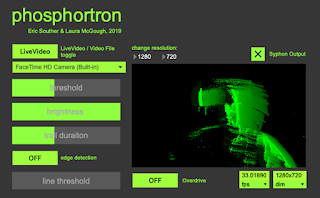
Yet another signal processing option to show sample output from: Phosphrotron by Eric Souther & Laura McGough
Phosphortron is a video instrument that emulates the phosphor trails found in analog cathode ray tube (CRT) oscilloscopes and television monitors. The instrument uses a computer vision technique called frame difference, which compares the current frame versus the previous frame and analyzes change based on a threshold pixel by pixel. The trail duration function controls how long previous information stays on screen before fading away the simulated phosphors. Edge detection is utilized in conjunction with frame difference, to isolate and accentuate the outlines to loosen the raster image towards the simulated aesthetics of vector drawing.
See more about the app: https://www.ericsouther.com/toolmaking-1
Eric is also one of a pair of developers, along with Jason Bernagozzi, for the powerful Signal Culture video processing apps: http://signalculture.org/appclub.html
One more circuit bent processing device to show sample output from: Circuit Bent Vizual Noize Enhancer Lofi Video Synth by statikstramentz
This unit takes composite video in and outputs, well as the name suggests, NOIZE enhanced video. Gotta be subtle with the adjustments or the signal will go out of NTSC spec range. Although statikstramentz recommends output to a good ol' analog CRT and thence rescan (or possibly projection?), I've found that the glitched signal is much more usable than expected - I can feed it into a composite-> HDMI converter and thence into a HDMI->USB digitizer for recapture on computer. I've even fed the output into a professional TBC with decent results. (Of course, you've got to experiment and move the unit's control knobs slowly because too far one way of the other WILL cause the signal to go out of spec and thus "blank out" the encoder or the TBC. Just sayin'...)
"This compact video synth has been created to let you conjure various warped distortions, smeared pixelations, overdriven white mosaics and other various effects. As usual with circuit bent video effects-differing effects can be achieved depending on what you connect to this device-both in and out. Composite video source (camcorder, DVD, VHS, etc.) input. Composite video output. For best/trouble free results, best viewed on / rescanned from an old school (analog CRT) television."
See sample work: instagram.com/statikstramentz
Find out more at his storefront:
https://www.etsy.com/listing/598871620/circuit-bent-vizual-noize-enhancer-lofi
I have also been using an analog-style software video synthesizer - Lumen - for the Mac. There's a wide range of synthesis and processing effects that can be achieved - way to much to delve into here... Been processing footage for my upcoming video program tentatively titled "River Styx."
"Lumen is a Mac App that makes it easy for you to create engaging visuals in real time. Use the same process with Lumen as you would with a hardware video synth, but with modern features only software can provide. With a semi-modular design that is both playable and deep, Lumen is the perfect way to get into video synthesis."
Check Lumen's features out: https://lumen-app.com
So I've been playing around with some new hardware signal processing devices. Of particular interest is the Waaave_Pool RPI system configured, programed and sold by Andrei Jay (who describes himself as 'a mathematician, video artist, educator, and soft/hardware designer.') Waave_Pool is very cool! I will be posting a number of short video clips processed thru it next. WAAAVE_POOL is a framebuffer delay/video feedback generator and video synthesis system based on a switchable feedback/feedforward video delay. For more info on the device: https://andreijaycreativecoding.com/WAAAVE_POOL He has other devices built around the same Raspberry Pie: https://andreijaycreativecoding.com/Video-Synthesis-Ecosphere-RPI
I'm posting a few of my early video works from 'back in the days' of neophyte vidiots, EAI, The Kitchen (in Soho), Mudd Club video nights, and analog video processing via The Experimental Television Center.
Chernobyl West 1986 (7:48)
Greetings From Vacationland 1986 (28:02)
I just completed a short video piece call "ORACLE" scrounging footage collected over the years. It's sort of the equivalent to an 'ear worm'... the idea has been floating around in my head for awhile. This makes use of real world footage and image processed footage (via LUMEN app for MacOS). The final program is 2:30 in length. Enjoy!
Remember what Morphius told Neo in The Matrix - "What was said, was said for you alone."
The newest update to PhotoRoom app has a feature that allows a cloud effect to be added in front of the subject or behind it in the background. Wanted to play with that a bit, so I decided to make use of a found image of this Hindu temple looming overhead. I also added the rays background to the masked temple object. I find the overall results to be exciting and evocative. (Check out the transparent mirage effect in the 3rd video!) Is there a possible temple / shrine / sacred ruin series brewing??
I came across another one of my Pareidolia videos - can't recall exactly how I created this. Anyway, the face is from a Marilyn Monroe video found somewhere on the web.
When I get a chance, I'll post a few more Pareidolia videos.
'Less Is More' is the current exhibition at Upstream Gallery. It's described as a Juried National Small Works Exhibition running from January 7th through January 31st. Open Thursday - Sunday, 12:30 - 5:30pm
8 Main Street, Hastings-on-Hudson, New York, 10706
email: UpstreamGallery26@gmail.com
gallery phone: 914-674-8548
I have work in the show - a small 5.5"x3.5"x3" sculptural piece entitled Portable Healing Shrine. This piece is built upon a found object (a small hand made, hand-painted Hindu shrine that I found at the AsiaBarong marketplace in Great Barrington). While the found shrine was rather crudely made and painted, I thought it would be fun to use the wooden framework to create a personal shrine using my own imagery.
A selection of images follow:| a front view of the shrine with all doors closed |
| the shrine under its protective glass jar in the gallery |
| the shrine with all outer doors open showing hands making offerings (multiple panels) and Protective Dakinis dancing on the doors of the inner-most realm |
| the doors of the inner sanctum opened to reveal the meditating Medicine Buddha flanked by flaming lotus flowers |
To be viewed full screen!
As my last "before and after" posting showing a source / reference "static" image used as the basis for a video haiku, I chose to offer one of my favorite Buddhaverse Variations to serve as a catchy lead-in to this batch of posts about my new series of short video animations.
The source image (from 2014-15) is a diptych showing Tara (on the right) and a Chod Dakini (on the left).
![]() |
| Chod Dakini & Tara |
This post is a "before and after" showing source images and one of the haiku animations inspired by them. The "before" images (from 2010) take the form of a protective Thangka referred to as a 'Jewel Tree' - a graphical lineage tree depicting a personalized chain of ancestors and teachers. (In this case, the first image - Jewel Tree 2 - includes my parents, my grandmother, and teachers such a the Dalai Lama and Terence McKenna. The second image - Jewel Tree 1 - shows me embodied as a teaching Buddha in the form of Avalokiteshavara.)
![]() |
| Jewel Tree 2 |
![]() |
| Jewel Tree 1 |
This post is another "before and after" showing the source image and one of the haiku animations inspired by it. The "before" is a healing and protective Thangka from 2005 showing a gathering of 21 Taras (of various colors: red, white, blue, green, yellow).
![]() |
| 21 Taras |
This post is a "before and after" showing the source image and one of the haiku animations inspired by it. The "before" is a Thangka from 2008 showing Vajrayogini drinking blood within a 6 pointed yantra (3d merkaba) surrounded by protective entities and other symbols.
![]() |
| Vajrayogini Medicine Thangka |
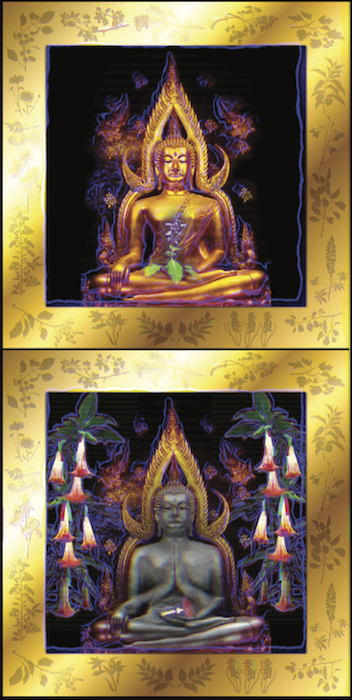
I created a number of "static" versions of the Medicine Buddha in the past. I especially liked the use of the golden frame with imprints of herbal remedies used on the square formatted Medicine Buddha portrait. I decided that this could serve as the framework for some video haikus in my Buddhaverse Variations series.
The square Medicine Buddha is shown surrounded by Dakinis and other protective beings. In front lie a number of offerings, some typical (such as the 'good luck' balls and medicine urn), others more esoteric and shamanistic (skull, mushroom, merkaba) included with a nod toward Tantric practice and its Bon roots. The offering items shown here have been used as visual elements throughout the new haikus.
![]() |
| Medicine Buddha With Offerings |
As I began to work on my new set of Tibetan inspired digital glitch animations ('haikus'), it seemed like a natural starting point to harken back to some of the Forest Guardian anims from last year as a starting point. Below are a couple of early Buddhaverse Variations haikus paired with examples of the Forest Guardian anim(s) that they derived from.
After showing samples of my first batch of digital glitch animations at the Upstream Gallery last fall, I was asked what was next? Since I had just completed jungle animals, nature spirits, and forest guardians (so called 'gods' and 'goddesses') as subject matter, why not try something with Tibetan Buddhist imagery which so much of my art work has been based upon? I thought that made sense, but just couldn't get my head around exactly how to approach this...
It was months into the pandemic playing with various IOS apps before I hit upon with a visual approach of image glitching of the source material that actually excited me. I thought it embodied the sense of energy auras that is illustrated in Tibetan art, esp. protective / wrathful entities.
Playing around further with other apps, I hit upon this preset that provided blue auric flames and variable glitching. This was exactly what I had been looking for! Here are a couple of examples:
Ultimately, this got my creative juices unblocked and I decided to build up a library of glitch-processed 'components' (figures, objects, backgrounds drawn from my previous static Thangka and Mandala work) which could then be composited together in a Photoshop timeline along with audio tracks (chants and other meditative sounds) to form the basis of a new series of short digital animations.
After working on the first 20 or so animation 'haikus,' I decided to name the series "Buddhaverse Variations" as it became apparent that one visual idea was naturally leading to another variant, sort of like a digital sketchbook. Currently I have 125 haikus (short animations) which collectively run to about 49 minutes of program time (including short interstitial titles for each haiku). I plan to exhibit these using a wide-format digital frame (capable of playing 1080p format resolution videos) as I did previously at the Upstream Gallery last year.
More excepts from digitized library of my Experimental Television Center analog processed video footage [t.k.]
The video below (from which IOS app, I sadly now forget - perhaps Kino Glitch?) is the closest I've been able to achieve to a simple H axis wobbulator raster FX performed in the digital realm.
Compare this to an actual Wobbulator raster FX (Nixon portrait) posted previously.
This is an example of footage I compiled and processed at ETC under the topic heading of 'Dreamtime'. It seems very hallucinatory or perhaps like a shamanic journey vision. The source footage was recorded at Storm King Art Park. Processing included the greytone 'wobbled' imagery rescanned from the Paik-Abe Wobbulator and keyed over the original. In this preset, the Wobulator control signals were set to create only a slight ripple in the horizontal scanlines, rather than creating a fully distorted 3D 'wrapped raster' effect. (This effect would be almost impossible to generate via today's digital apps.)
This is an example of footage I compiled and processed at ETC under the topic heading of 'tide pools' recorded originally at Point Reyes seashore in Marin County, CA. Colorization, frame buffering, slowmo, and luma-key processing was applied to the anemones in the pools as waves came rushing in and flowed back out. There is one spot in this sample (00:55) where the chaotic water becomes totally abstract, finally resolving into bubbly foam. (This is an example of an analog image processing preset that could be replicated today with digital apps.)
This is an example of footage I compiled and processed at ETC under the topic heading of 'diaspora' to eventually make use in a video about dislocation due to environmental or political disruptions. The original footage was recorded during a Halloween parade in Oswego, NY (where the Experimental Television Center was located) during one of my residencies there. Of particular interest is the red/blue alternating colorization being triggered by a low frequency square wave controlling the signal processing. Also, note the great high-contrast scan line graininess possible thru use of rescan.
PS: note the great skeleton zombie carrying rifle costume on the young boy walking this his father (at around 00:45).
This is an example of footage I compiled and processed at ETC under the topic heading of 'rowing a boat' to eventually make use in a video about death, Bardo, and spiritual transition - the core symbolism of rowing being from the Greek myth of the Boatman Acheron rowing newly deceased souls across the River Styx into the Hell realms.
After a long pandemic pause, I'm back to posting new stuff on my Image Maya blog. You might ask what have I been doing? Actually, I've spent the time quite resourcefully pulling together a complete system to digitize all of my library of video tapes that have languished in a cupboard for way too long... My tape library starts back in the early 1980's with my first 1/2" Beta portable unit (from CTL Electronics in lower Manhattan (my old Tribeca loft neighborhood). After a handful of well-used Beta portables, I jumped in the Hi8 bandwagon - smaller, lighter weight, better quality (?). Then off to digital DV land when that format became available. Meanwhile, as a vidiot producing video art work in the 80's and early 90's, I did all my Master productions on an industrial A/B roll 3/4" U-matic system.
Needless to say, I faced hundreds of hours of video inventory from my travels around the world to digitize. On top of that, I had over 60 3/4" reels of image processed footage from my residencies at the Experimental Television Center (ETC). These are what I consider to be the 'crown jewels' from the days of analog video processing using tools such as the Jones Colorizer, the Paik-Abe Wobbulator, and other signal processing and keying devices. At the time, the only digital device available at ETC was an one-of-a-kind Jones Frame Buffer (which did just that - buffered a set of video frames for looping, freeze framing, and delaying). Of course, key to the whole production process was using video cameras to rescan off of monitors which allowed for multiple levels of processing effects (way beyond simple feedback). In the case of the Wobbulator, a raster distortion device manipulating H & V frequencies of a CRT display, the only way to actually make use of its range of processing effects was by rescan. (In any case, in hindsight there was a whole lot of glitchy / processed stuff one could easily do in the analog realm that have no direct analog in digital software-based processing. Exhibit A: the Wobbulator, which became my favorite tool.)
The process in the ETC studio for me involved selecting source footage from my video library and passing that thru the various hot-patched processing devices, and finally back to tape. Because of the analog nature of the controls, real time modifications and tweaking (playing around with settings and patches) was the norm. So typically once a record tape got rolling, a long 5-15 minute 'play' session would resulted. Fine. But of course, unlike many other video folks engaged in image processing triggered by music or electronic sounds (think of early Mudd Club visual music stuff), I was interested not in the durational / abstract / generational element of the process, but rather in generating 15-30 second, perhaps 2 minute long processed segments to incorporate into my video narratives.
With that as background, I decided the shutdown provided me a window of time to digitize my source videos before the inevitable wear of time made the tapes unplayable physically, either due to tape decay or unavailability of obsolescent decks to play such. I calculated that I'd need around 6TB of storage for all of my material, stored at DV's equivalent to pre-HD analog resolution: 720x480. And lots of time - as digitizing tapes is by its very nature 'real time'. Plus, I wanted to create a tape index of locations, subjects, and scenes to make finding interesting material possible in the virtual haystack. (I have started by using EXCEL spreadsheets, with a goal of creating a true relational database... sooner than later...)
And of course, every video deck I owned needed repair servicing after being idle in the closet for 20+ years. Or I had to buy something off EBAY...
So all of that has been taking time.
But that's not all - I've also been working on a series of digital glitch animations based upon my Tibetan Buddhist art. But more on that in a later posting.
For now, I want to post several short video excepts from some of the ETC processed footage.
| Image of an experimental color CRT Wobbulator being built at Signal Culture labs. |
| Wobbulated still image of Nixon |
![]() |
| Animation of a sequence of still Wobbulated images |
You may download or copy any image file (limit of 3) for use in your website as long as proper credit is provided: "Copyright 2003-2025 by Mark Gilliland - http://www.image-maya.org" This credit tag may be included as a caption, or alternatively within the IMG element's "ALT" attribute. (See details of the Creative Commons Attribution-No Derivative Works 3.0 License via link below.)
Please email to notify me about any such use of my art. Thank-you.