Recently, Eric Souther (Philosophical Tools on Patreon) released his latest Touch Designer TOX network for video processing called "VectMandala" - here is a sample of something I generated using it:
(turn up audio)

Recently, Eric Souther (Philosophical Tools on Patreon) released his latest Touch Designer TOX network for video processing called "VectMandala" - here is a sample of something I generated using it:
(turn up audio)
Another project I've been working on is the development of some GLSL shaders (in Touch Designer) with the help of Anthropic's Claude AI. (Use of an AI coding assistant is another whole subject best left for discussion over a bottle of beer...)
I got interested in seeing what sort of psychedelic procedural patterning could be created after coming across trippy artwork by @848elle on Tumblr (848ellie.tumblr.com). She's making use of an AI rendering engine (not sure which one) to create wonderful multi-faceted patterning. A few samples of her work appear below.


So once the Wobbulator unit itself has been constructed and successfully tested, that's only the first step in the larger journey... as discussed in the (previously posted) Wobbulator documentary by Blaire Neil, the device's coils need high power (at least 75 Watts per channel) audio to control the individual deflection coils (H,V, "S" coils). So that means the setup requires at least 3 separately controllable channels of audio power amplification (in my case, I made use of a pair of Sony home entertainment system receivers/amps found on EBay). And you need three sources of audio control. I decided to make use of a software emulation of a Eurorack setup, customized with three channels of oscillators and output gain controls. (The free PD software is "VCV Rack 2".) These VCV synthesized signals are fed out of my computer via a set of USB audio interfaces (Behringer U-Control units), to the audio power amps, and thence to the Wobbulator coils inputs. Of course, you also need a camera to rescan the Wobbulator's screen. (I found an old Hi8 camcorder on Ebay that does the trick. But there are a lot of video recording possibilities - the only limitation being the ability to manually focus and zoom!)
Below are a couple of examples from my Wobbulator at work in my studio. I have tuned the "H" coil frequency to create accentuated scaliness, and the "S" coil frequency to create the raster wobble.
Sample Haikus from Buddhaverse Variations ©2020-21
Sample Haikus from Buddhaverse Variations ©2020-21
Sample video (Haiku #006) from Buddhaverse Variations ©2020-21
Sample video (Haiku #008) from Buddhaverse Variations ©2020-21

 |
| Self Portrait as Thai Medicine Buddha (00:15) |
 |
https://vimeo.com/showcase/7916179 |
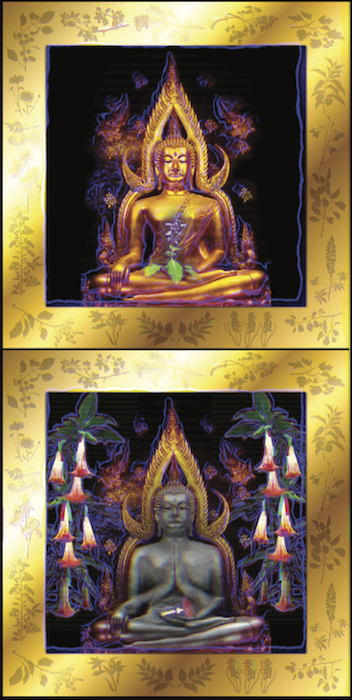
I created a number of "static" versions of the Medicine Buddha in the past. I especially liked the use of the golden frame with imprints of herbal remedies used on the square formatted Medicine Buddha portrait. I decided that this could serve as the framework for some video haikus in my Buddhaverse Variations series.
The square Medicine Buddha is shown surrounded by Dakinis and other protective beings. In front lie a number of offerings, some typical (such as the 'good luck' balls and medicine urn), others more esoteric and shamanistic (skull, mushroom, merkaba) included with a nod toward Tantric practice and its Bon roots. The offering items shown here have been used as visual elements throughout the new haikus.
 |
| Medicine Buddha With Offerings |
As I began to work on my new set of Tibetan inspired digital glitch animations ('haikus'), it seemed like a natural starting point to harken back to some of the Forest Guardian anims from last year as a starting point. Below are a couple of early Buddhaverse Variations haikus paired with examples of the Forest Guardian anim(s) that they derived from.
After showing samples of my first batch of digital glitch animations at the Upstream Gallery last fall, I was asked what was next? Since I had just completed jungle animals, nature spirits, and forest guardians (so called 'gods' and 'goddesses') as subject matter, why not try something with Tibetan Buddhist imagery which so much of my art work has been based upon? I thought that made sense, but just couldn't get my head around exactly how to approach this...
It was months into the pandemic playing with various IOS apps before I hit upon with a visual approach of image glitching of the source material that actually excited me. I thought it embodied the sense of energy auras that is illustrated in Tibetan art, esp. protective / wrathful entities.
Playing around further with other apps, I hit upon this preset that provided blue auric flames and variable glitching. This was exactly what I had been looking for! Here are a couple of examples:
Ultimately, this got my creative juices unblocked and I decided to build up a library of glitch-processed 'components' (figures, objects, backgrounds drawn from my previous static Thangka and Mandala work) which could then be composited together in a Photoshop timeline along with audio tracks (chants and other meditative sounds) to form the basis of a new series of short digital animations.
After working on the first 20 or so animation 'haikus,' I decided to name the series "Buddhaverse Variations" as it became apparent that one visual idea was naturally leading to another variant, sort of like a digital sketchbook. Currently I have 125 haikus (short animations) which collectively run to about 49 minutes of program time (including short interstitial titles for each haiku). I plan to exhibit these using a wide-format digital frame (capable of playing 1080p format resolution videos) as I did previously at the Upstream Gallery last year.


You may download or copy any image file (limit of 3) for use in your website as long as proper credit is provided: "Copyright 2003-2025 by Mark Gilliland - http://www.image-maya.org" This credit tag may be included as a caption, or alternatively within the IMG element's "ALT" attribute. (See details of the Creative Commons Attribution-No Derivative Works 3.0 License via link below.)

Please email to notify me about any such use of my art. Thank-you.

 Posts
All Comments
Posts
All Comments


